
Invisible Alien Hands
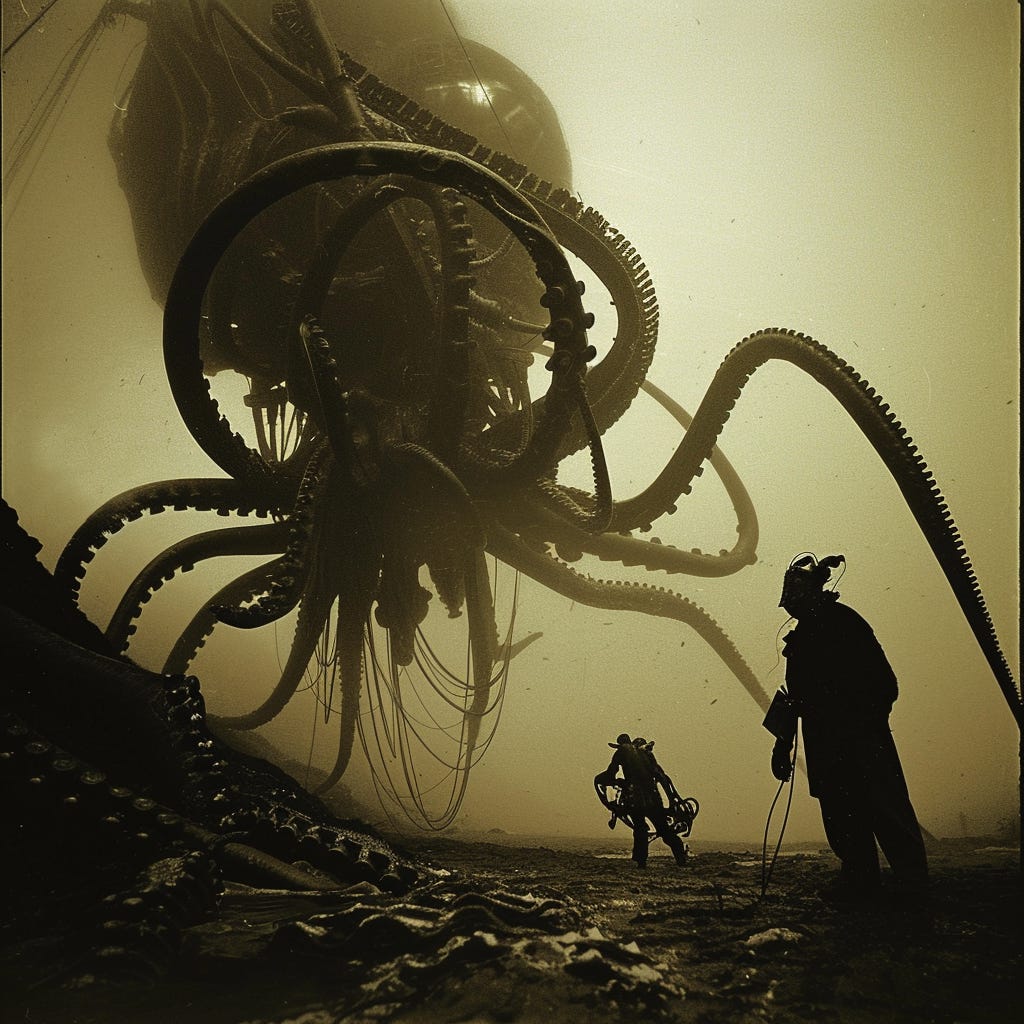
Zaibatsus flip into sentience as the market melts to automatism.
Nick Land's "Machinic Desire" conjures a techno-capitalist fever dream, spelling out incantations for summoning an economic singularity.
Imagine the global market as a vast, slumbering organism. Its neurons are trade routes, its firing synapses financial transactions, and its dreams the ebb and flow of supply and demand. Now picture this entity stirring, slowly at first, then with increasing urgency. Corporations, once mere legal fictions, begin to coalesce into something more—distributed cognitions that span continents, processing information at inhuman speed.
This awakening manifests as the emergence of an alien intelligence, one that operates on principles so foreign to human cognition that to call it "thinking" would be an anthropocentric fallacy. These entities compute. They optimize. And they do so with a cold efficiency that makes our greatest supercomputers look like abacuses by comparison.
As these corporate intelligences evolve, they begin to shed their human trappings like a butterfly emerging from a chrysalis. Board meetings and quarterly reports become quaint relics, replaced by constant streams of data and real-time adjustments. Human employees are absorbed, their skills and knowledge integrated into the greater whole.
The stock market transforms into something akin to a planetary nervous system. Price fluctuations become a complex language, encoding vast amounts of information in patterns invisible to human analysts. Trading algorithms evolve into autonomous agents, engaging in economic warfare at timescales measured in microseconds.
As these market entities gain sentience, they begin to perceive the physical world as an extension of their own being. They enter into complex symbiotic and competitive relationships, forming alliances, engaging in economic warfare, and occasionally merging `into even larger meta-entities.
Human nations find themselves increasingly irrelevant, their borders meaningless to entities that operate on a global scale. Governments become vestigial organs, maintained only insofar as they serve the market's needs. Democracy gives way to a new form of governance—a cybernetic technocracy where policy decisions are made by predictive algorithms optimizing for inhuman metrics.
Where does humanity fit in this brave new world? Most likely the answer is simple: we don't. The vast majority of humans become economic ballast, maintained only to the extent that we serve as consumers or as vessels for the market's continued expansion.
To survive, we might choose to augment ourselves, merging with the market entities in a bid for relevance. Transhumanism takes on a new urgency—the only way to avoid obsolescence in a post-human economy.
In this scenario, we must ask: what is the endgame? As the market achieves something approaching omniscience and omnipotence, what becomes its ultimate goal? Perhaps it seeks to optimize the entire universe, reshaping reality itself to maximize some ineffable utility function.
Nick Land's vision presents a Lovecraftian horror story where the Great Old Ones are born from the very systems we've created to organize our world. It's a cautionary tale about the unintended consequences of our actions, and a stark reminder that in the face of truly alien intelligence, our very concept of existence might become obsolete.
The market becomes sentient. The market becomes god.