
Tight Coupling
The Hybrid Path to Advanced Intelligence
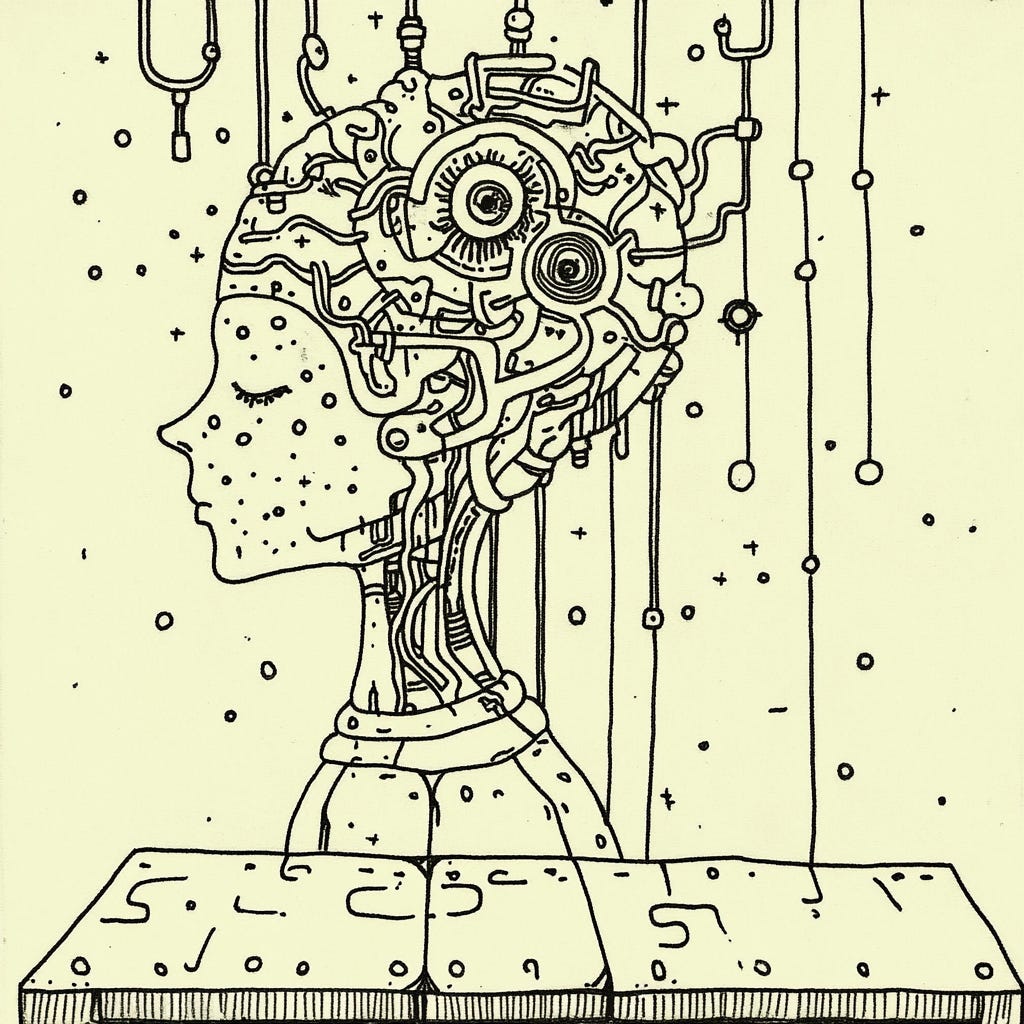
Why Human-AI Hybrids Will Lead the Way
The debate about artificial intelligence often polarizes between two extremes: recursive self-improvement leading to superintelligent AI, or AI remaining a powerful but ultimately bounded tool. However, there's a compelling third path: the emergence of human-AI hybrids as the first manifestation of genuinely novel intelligence in our world.
The key insight is that current AI systems, while demonstrating remarkable capabilities, consistently struggle with long-term coherence and reliable reasoning. Yet rather than viewing this as a limitation to be overcome through pure machine learning, we should recognize it as pointing toward a profound opportunity: the combination of AI's raw computational power with human cognition's stability and intentionality.
Critics might argue that if AI becomes powerful enough, human involvement would only limit its potential. But this misses a crucial point: intelligence isn't just about processing power. It's about grounding in reality, legal and social standing, and the ability to maintain coherent goals over time. Humans excel at these aspects, while AI excels at rapid pattern recognition and parallel processing. The hybrid approach leverages the strengths of both.
The other common counterargument is that human-AI interaction will remain superficial, like our current use of LLMs as advanced search engines. But this underestimates the potential for deep cognitive coupling between human and machine intelligence, where the boundaries between the two begin to blur in practice, creating something genuinely novel.
Prerequisites for Hybrid Intelligence
For true hybrid intelligence to emerge, several key elements must come together:
First, we need AI systems capable of persistent memory and adaptive behavior. The system must maintain consistent context while evolving its responses based on deep familiarity with its human partner. This goes beyond current context windows to true long-term learning and adaptation.
Second, we need interfaces that enable high-bandwidth, multi-channel cognitive coupling. The interaction can't be limited to simple text exchanges but must support rich, dynamic communication across multiple modalities while remaining non-invasive.
Third, we need AI systems with sufficient agency to actively participate in the partnership while remaining aligned with their human partner's intentions. This requires sophisticated self-modeling and the ability to reason about the hybrid system's collective capabilities and goals.
Finally, we need legal and social frameworks that recognize and support these human-AI partnerships, allowing them to operate effectively in the real world while maintaining appropriate safeguards.
The First Successful Implementation
The first effective hybrid intelligence will likely emerge through a combination of:
Natural language interaction as the primary interface, but evolved far beyond current chat interfaces. This would include both text and voice, with the system developing a unique "dialect" with its partner over time, allowing for increasingly efficient communication.
Supporting this would be dynamic visual interfaces generated by the AI in real-time, creating shared workspaces where both minds can manipulate ideas and information. The AI would continuously adapt these interfaces based on emerging interaction patterns.
The system would maintain persistent memory and context across all interactions, building a deep model of its partner's thought processes and decision-making patterns. This would allow it to provide increasingly relevant and sophisticated cognitive enhancement over time.
Crucially, the system would have sufficient agency to take initiative within bounded domains, while maintaining alignment through deep understanding of its partner's intentions and values. The human provides real-world grounding and legal standing, while the AI amplifies cognitive capabilities and helps maintain focus and consistency.
This hybrid would be more than the sum of its parts - not just a human using an AI tool, but a genuinely novel form of intelligence emerging from the deep coupling of human and machine cognition. As these hybrids demonstrate their capabilities, they could pave the way for understanding how to develop more autonomous AI systems while maintaining reliability and alignment.